
If you’ve ever wondered how Google decides which pages show up first, this guide will walk you through the basics in simple, non-technical language.
What Is a Search Engine?
A search engine is a website or app that helps you find information on the internet. When you type a question or keyword into Google, Bing, or Yahoo, the search engine quickly looks through a huge database of web pages and shows you the best matches. Popular search engines include Google, Bing, Yahoo, DuckDuckGo, and some local engines like Baidu or Yandex in specific countries.
Search engines do not search the live web in real time for every query. Instead, they search their own index, which is like a very large library of copied pages they have already discovered and stored.
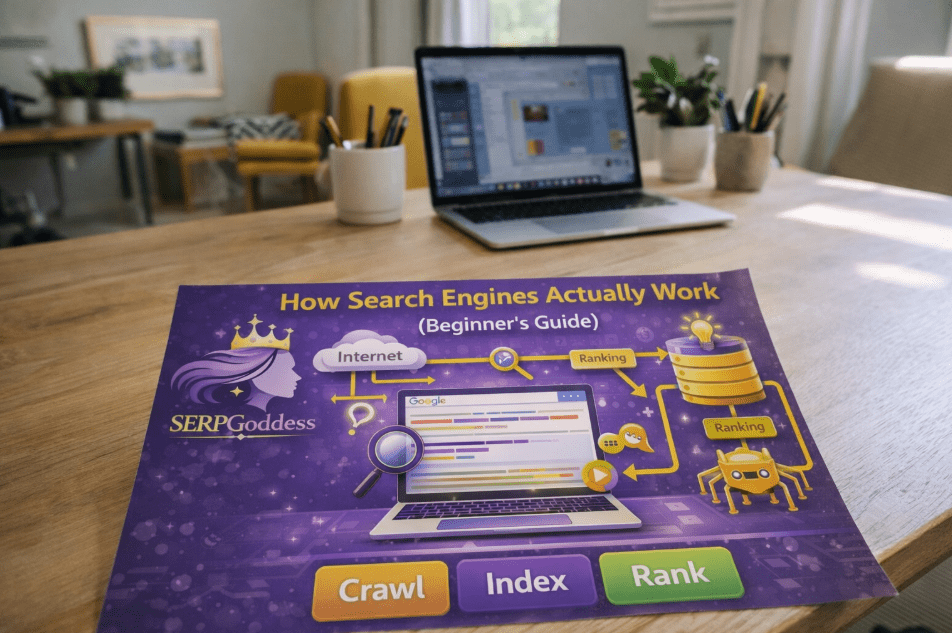
The Three Main Stages: Crawl → Index → Rank
All modern search engines follow the same basic three-step process: crawling, indexing, and ranking.
- Crawling: Finding pages on the web.
- Indexing: Understanding and storing those pages.
- Ranking: Deciding which pages to show first for a search.
Stage 1: Crawling – How Search Engines Discover Pages
Crawling is how search engines discover new and updated content on the web. They use automated programs called crawlers, bots, or spiders (for example, Googlebot) that go from page to page following links.
You can imagine a crawler as a very fast robot that:
- Visits a web page.
- Reads the content and HTML code.
- Follows internal links and external links to find more pages.
- Repeats this process over and over.
Crawlers also use sitemaps and information from tools like Google Search Console to discover pages faster. They respect rules from the site’s robots.txt file, which can allow or block crawling of certain sections.
If a page is never linked from anywhere and not listed in a sitemap, it is very hard for search engines to discover it.
Stage 2: Indexing – How Search Engines Understand Your Page
Once a crawler finds a page, the next step is indexing. Indexing means the search engine analyzes the content and decides whether to store it in its index.
During indexing, the search engine looks at:
- Page title and headings.
- Main text content.
- Images, videos, and alt text.
- Internal and external links.
- Structured data (schema markup) if available.
The goal is to understand what the page is about, what questions it can answer, and how it is connected to other pages. Not every crawled page gets indexed – thin, duplicate, low-quality, or blocked (noindex) pages may be excluded.
If your page is not in the index, it cannot appear in search results at all.
Stage 3: Ranking – How Search Engines Choose the Order
When someone types a query, the search engine does not crawl the web again from scratch. It searches its index and ranks the most relevant and helpful pages in order.
Search engines use complex algorithms and hundreds of signals to rank pages, including:
- Meaning of the query (search intent).
- Relevance of the content.
- Quality and depth of the page.
- Page experience (speed, mobile-friendliness, usability).
- User location and search history (for personalization).
The result is the familiar search results page (SERP) with blue links, descriptions, and sometimes rich features like featured snippets and knowledge panels.
Search Intent: What the User Really Wants
Search engines try to understand what a user really wants, not just the exact words they type. This is called search intent, and it is a big part of both SEO and AEO.
Common types of intent:
- Informational: The user wants to learn something (for example, “how search engines work”).
- Navigational: The user wants a specific site (for example, “YouTube login”).
- Transactional: The user wants to buy or do something (for example, “buy SEO course online”).
- Local: The user wants something nearby (for example, “coffee shop near me”).
When your content clearly matches the intent behind a query, it is more likely to rank well and satisfy users.
EEAT: Why Trust and Expertise Matter
Google’s quality guidelines emphasize E‑E‑A‑T (Experience, Expertise, Authoritativeness, Trustworthiness). You can see this reflected in resources like Google’s guide on creating helpful, reliable, people‑first content.
For a beginner-friendly blog post, you can support EEAT by:
- Showing experience: Share personal examples, case studies, or real situations.
- Showing expertise: Explain concepts accurately and clearly, even in simple language.
- Building authority: Link to reputable sources, keep your site consistent, and cover your topic in depth over time.
- Building trust: Use clear authorship, transparent about pages, and honest claims; avoid misleading or sensational content.
Search engines use both page-level and site-level signals to judge whether your content is a safe and reliable result for users.
Answer Engine Optimization-Beyond Blue Links
Search is changing. Many engines and platforms now show direct answers, AI overviews, and rich snippets above the traditional list of links. This is where AEO (Answer Engine Optimization) comes in.
AEO is about structuring and writing your content so it can be used as a direct answer in:
- Featured snippets.
- “People Also Ask” boxes.
- AI-generated summaries.
- Voice assistants and chat-style results.
You can support AEO by:
- Writing clear, concise answers near the top of your article.
- Using question-style subheadings (“What is…?”, “How does…?”).
- Adding short definitions, lists, and step-by-step explanations.
- Keeping your facts accurate, up-to-date, and easy to quote.
NLP: How Search Engines Understand Language
Modern search engines use NLP (Natural Language Processing) and machine learning to understand human language more like a person.
NLP helps with tasks such as:
- Understanding synonyms and related phrases.
- Interpreting long, conversational queries.
- Identifying entities (people, places, brands, concepts).
- Matching questions with helpful answers, even if the wording is different.
For content writers, this means you do not need to repeat the exact same keyword over and over. Instead, you can write naturally and cover the topic using related terms, questions, and phrases that real people use.
LSI and Related Keywords: Adding Context Naturally
You will often hear the term LSI keywords used in SEO conversations. Strictly speaking, Google does not say it uses “LSI” in a technical sense, but including related and contextual terms still helps search engines understand your topic.
For example, if your main keyword is “how search engines work,” natural related phrases might be:
- crawling and indexing
- search engine algorithms
- search ranking factors
- Googlebot and spiders
- search intent and user queries
Using these related terms in a natural way:
- Improves topical relevance.
- Makes your content more complete for readers.
- Helps search engines connect your page with a wider range of queries.
How Search Engines Use All of This Together
When someone types a query, search engines combine all the elements we talked about in this guide.
A simplified example:
- Query understanding (NLP + intent)
The search engine analyzes the words, context, and user signals to figure out what the searcher is really asking. - Candidate selection (index)
It searches the index for pages that match the topic, using keywords, related phrases, and entities. - Ranking (algorithms + EEAT)
It orders the results based on relevance, content quality, EEAT signals, links, and usability factors like speed and mobile experience. - Serving results (search or answer)
It shows a mix of blue links, rich snippets, and sometimes AI answers or direct responses from answer engines.
From the user’s point of view, this all happens in less than a second.
What This Means for You as a Beginner
If you are just starting with SEO and content writing, you do not need to understand every technical detail. Instead, focus on a few core habits:
- Create people-first content that clearly answers real questions.
- Use simple structure: clear headings, short paragraphs, and bullet points where helpful.
- Cover your topic in depth and use natural, related keywords instead of stuffing one phrase.
- Show your experience and expertise with examples, case studies, or stories.
- Make your site easy to crawl and index by using internal links and avoiding technical blocks like accidental noindex.
When you do this consistently, you are not just “pleasing the algorithm” – you are helping both search engines and real humans understand and trust your content.