
Quick Answer
AI Overview didn’t magically destroy your visibility.
It simply made it easier for Google to skip sites that haven’t kept up with how AI and search now work together.
In this guide, I’ll break down:
What AI Overview actually is (in plain language)
How Google decides which sites to cite in AI Overviews
Why your website might be getting quietly filtered out
How to adjust your content, structure, and strategy so you show up in AI Overviews, answer engines, and classic SERPs without turning your site into an AI content farm
If your traffic has dropped, your rankings feel unstable, and your best content suddenly isn’t pulling the clicks it used to, you’re not imagining it.
Google’s AI Overview has changed how search works—and it’s exposing which websites are truly helpful and which are just “SEO content” wrapped in keywords.
But here’s the nuance most “AI killed SEO” hot takes ignore:
What Is AI Overview?
AI Overview as Google’s
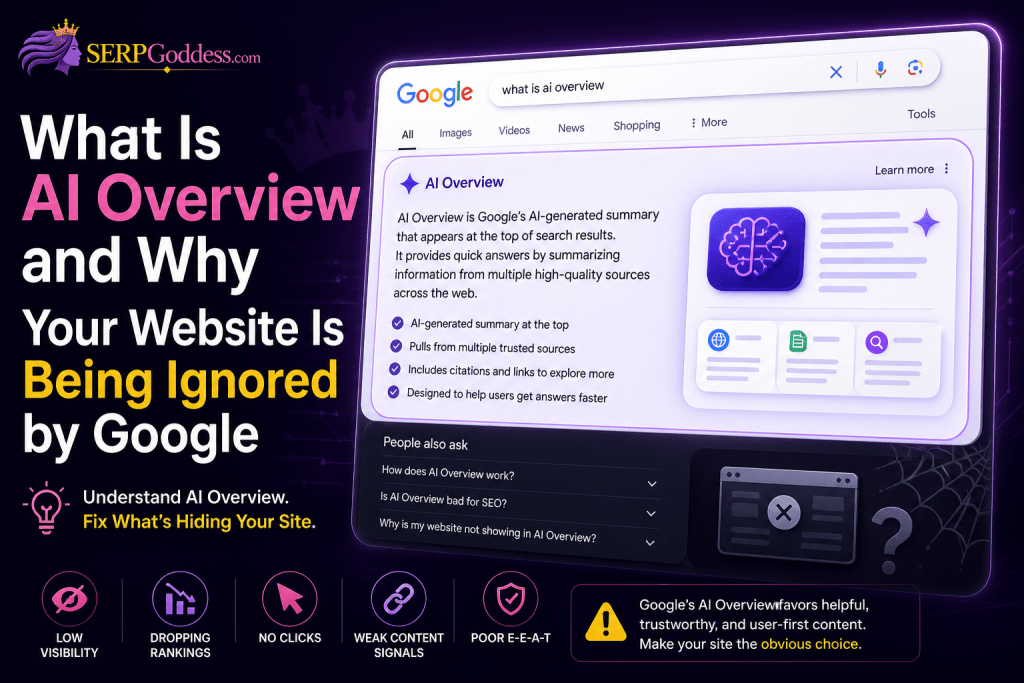
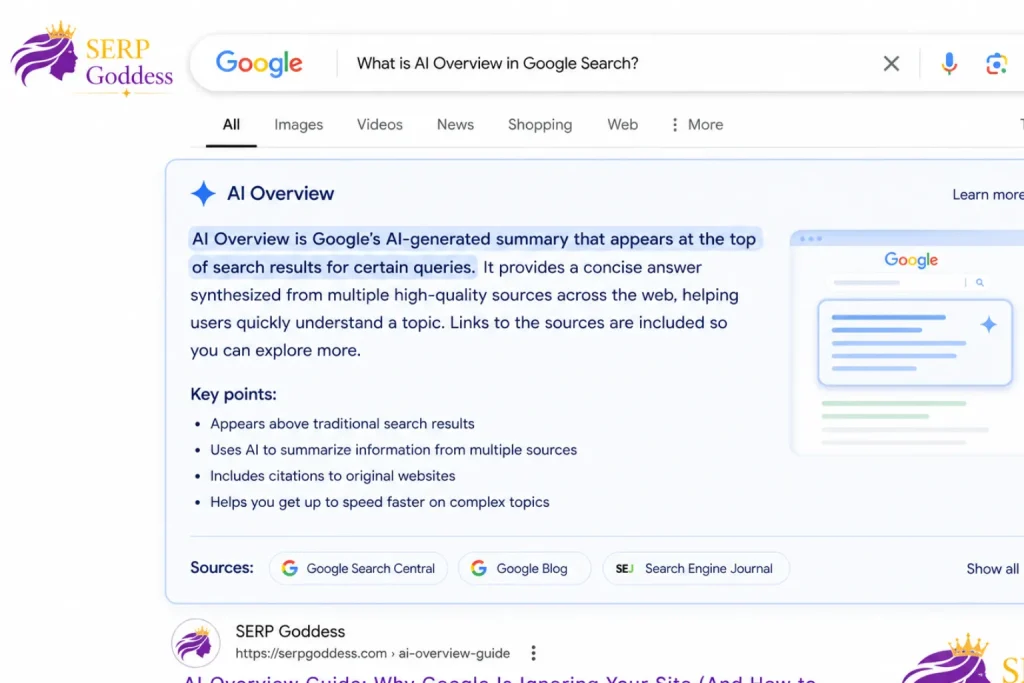
AI Overview is Google’s AI‑generated summary that appears at the top of some search results, especially for informational or complex queries.
Instead of only seeing 10 blue links, users may now see:
- A short, paragraph‑style explanation
- Bullet points covering key sub‑questions
- Links to the websites Google used to build that summary
Google itself describes AI Overviews as a way to “quickly get up to speed on a topic by showing a snapshot of key information with links so you can explore more on the web.” You can see Google’s own explanation on the official AI Overviews page.
In practical terms, AI Overview is:
A summary layer on top of the classic SERP, generated by AI, that pulls in content from multiple sources and gives users a quick “overview” before they decide what to click.
From a user perspective, AI Overview:
- Reduces the need to open multiple tabs
- Surfaces definitions, steps, and context quickly
- Helps them refine or branch their query faster
From a site owner perspective, AI Overview:
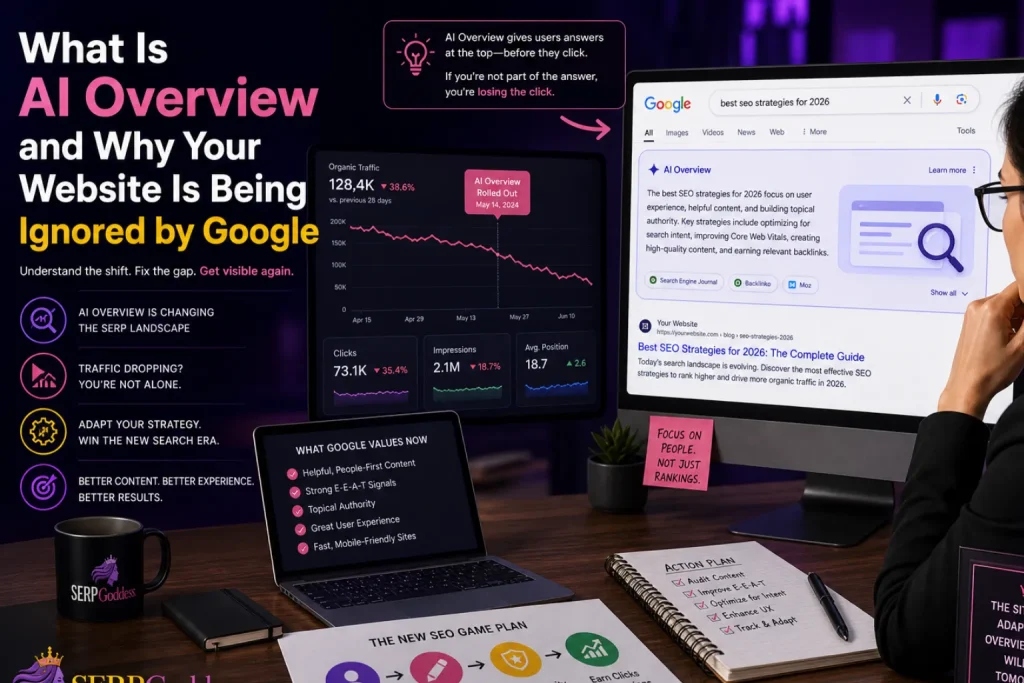
- Can reduce some traditional clicks (more “zero‑click” behaviour)
- But also introduces a new “slot” to win: being cited directly inside the AI Overview box
If your pages are never cited there, you’re competing in a smaller part of the screen than before.
How Does Google AI Overview Work?
We don’t need to reverse‑engineer every model Google uses. But we do need to understand the workflow behind AI Overview.
Step 1: Understand the user’s intent (and sub‑intents)
AI Overviews tend to trigger when:
- A query involves multiple angles or steps
- The answer isn’t fully captured in a single sentence
- Users would usually click several results to piece together an understanding
For example:
- “how to create an ai content strategy for seo”
- “ai overview vs featured snippet vs people also ask”
- “best ai tools like chatgpt gemini perplexity claude copilot 2026”
Google uses AI and machine learning systems (like RankBrain, BERT, and other language models) to interpret that intent at a deeper level. If you want a neutral primer on how AI systems interpret language and information, resources like What Is Artificial Intelligence? – Google Cloud and Encyclopaedia Britannica’s AI overview are useful context.
Step 2: Identify credible, extractable sources
To generate an AI Overview, Google needs content that is:
- Topically relevant to the query and related entities
- Well‑structured (clear headings, logical sections)
- Trustworthy, based on E‑E‑A‑T (experience, expertise, authoritativeness, trustworthiness)
- Extractable, meaning it has clean, self‑contained passages that can be lifted and summarised
SEO and AI search guides consistently show that AI Overviews favour content that’s already high‑quality and easy to parse, such as these breakdowns from WordStream, Mangools, and Nightwatch.
Step 3: Generate a summary and attach citations
Once suitable sources are identified, Google’s AI:
- Synthesises key points into a concise answer
- Organises information into short paragraphs or bullet lists
- Links back to the underlying pages that support each part of the answer
Your content can either:
- Become a building block inside that AI summary, or
- Sit in the background while competitors get their content lifted and cited
Your goal is not to trick the system it’s to make your content the obvious choice to quote.
Why Your Website Is Being Ignored by AI Overview (and Google)
If AI Overview rarely cites you—or if your overall organic visibility has faded—there’s usually a combination of strategy and structure issues.
1. Your content isn’t “AI‑extractable”
AI Overviews favour content that:
- Answers specific questions clearly and early
- Uses headings that mirror how users actually search
- Breaks concepts into short, focused paragraphs and bullet lists
AI summarisation best‑practice content (for example, Box’s AI summarisation guide and similar articles) emphasises that concise, self‑contained segments are easier for models to reuse.
If your content:
- Opens with a long, fluffy intro before answering anything
- Uses clever or vague headings instead of plain‑language questions
- Buries definitions and key explanations halfway down the page
…then AI has to work harder to reuse you—and often won’t bother.
Ask yourself:
- Can a skimming user or AI model quickly grab a 2–3 sentence snippet under a heading and understand exactly what it’s answering?
- Do your H2s/H3s look like “What is AI Overview?”, “How does Google AI Overview work?”, “Is AI Overview bad for SEO?”—or more like “The New Era of Search Magic”?
The first style is extractable and AEO‑friendly. The second is cute, but costly.
2. You’re still publishing “SEO articles”, not helpful answers
Signs your content is stuck in pre‑AI SEO mode:
- Every post follows the same template: “What is X? Benefits of X. How to use X. Conclusion.”
- No original examples, screenshots, data, or frameworks
- Heavy use of AI for drafting with minimal human editing or expertise
- Targeting broad keywords with no clear, specific slant
Practitioner and tool guides about AI Overviews highlight that thin rewrites and generic listicles are far more likely to be ignored or down‑ranked now—Google just has better tools to filter them.
If a language model could have written 90% of your post without your input, Google has little reason to choose your version over more established domains.
3. Weak E‑E‑A‑T and author signals
Google’s E‑E‑A‑T framing matters even more in an AI‑heavy environment:
- Experience — have you actually done what you’re writing about?
- Expertise — do you understand the topic beyond surface definitions?
- Authoritativeness — are you recognised for this topic in any way?
- Trust — is your site transparent, consistent, and safe?
If your site:
- Has thin or generic author bios
- Hides who is behind the content
- Covers dozens of unrelated topics without a clear focus
- Has minimal external references or profiles backing your expertise
…you will lose to brands and creators who show their work and identity more clearly. Google’s own AI and search documentation (Google Cloud, Search Essentials, and AI explainers) all align with this trend.
Linking out to credible references when defining AI and AI Overview—like Notre Dame’s AI overview and definitions, Britannica’s AI article, and Google’s own What is AI?—also reinforces that you’re grounded in reliable sources.
4. Your topical structure and internal links are confusing
AI Overview doesn’t see pages alone; it sees topics and site ecosystems.
Best‑practice guides on AI Overviews and generative search stress that clear internal linking and topic clusters make it easier for search systems to understand your authority.
If your site:
- Has multiple overlapping posts targeting the same query without a clear “pillar”
- Doesn’t funnel authority into a main AI Overview / AI SEO hub page
- Uses ad‑hoc internal links instead of structured clusters
…then you’re diluting the topical signals AI Overview is tuned to look for.
For this article, you want it to be your:
- Main AI Overview hub, internally linked from:
- Your outdated SEO strategy article
- Any AI + SEO workflow guides
- Content audits / AI content cleanup pieces you publish later
And from here, you should link out to a handful of high‑authority external resources explaining AI, AI Overviews, and modern optimisation:
- AI context → Google Cloud: What Is AI?, Britannica: Artificial intelligence
- AI Overviews specifics → Google AI Overviews overview, WordStream: AI Overviews guide, Mangools: AI Overviews, Nightwatch: AI Overviews
- AEO / GEO concepts → Writer: GEO & AEO SEO guide, HubSpot: AEO guide, Elementera: AEO strategies
That combination of internal focus + external authority is exactly what E‑E‑A‑T and AI‑driven search experiences reward.
AI Overview vs Traditional “AI Overview” Articles
There’s an important distinction:
- “AI Overview” (feature) = Google’s AI‑powered summary layer in search.
- “AI overview” (content type) = any generic “what is AI” article.
This article is a hybrid:
- It targets the keyword “AI overview”
- It explains Google AI Overview as a feature
- It shows readers why their sites are being ignored if they haven’t evolved
- It is optimised for AEO (Answer Engine Optimization) and GEO (Generative Engine Optimization), not just classic SEO
To support that hybrid angle, it helps to reference well‑structured AI primers like:
This signals that you understand AI in a broader context, not just as a ranking feature.
AI Overview vs Featured Snippet vs Answer Engines
| Feature | AI Overview | Featured Snippet | Answer Engines (ChatGPT, Perplexity) |
|---|---|---|---|
| Source | Multiple pages | Single page | Multiple + model knowledge |
| Format | AI summary | Extracted snippet | Conversational answer |
| Citations | Yes | Limited | Often yes |
| Complexity | Multi-angle queries | Simple queries | Deep + contextual |
| Click Impact | Medium–High | Medium | Low–Medium |
Featured snippet:
- Pulls a short passage, list, or table from one page
- Shows it in a box at the top of the SERP
- Often answers simple definition, comparison, or how‑to queries
AI Overview:
- Synthesises content from multiple pages
- Handles more complex, multi‑angle queries
- Links to several sources for different parts of the answer
Structured, well‑labelled content can win both the featured snippet and inclusion inside AI Overview, as shown in analysis from WordStream, Mangools, and Search Engine Land’s optimisation guide.
Your strategy: write with both in mind.
AI Overview vs Answer Engines (ChatGPT, Gemini, Perplexity, Claude, Copilot)
Large AI tools like ChatGPT, Google Gemini, Perplexity, Claude, and Microsoft Copilot act as answer engines, providing conversational responses based on:
- Training data
- Live web access (for some tools)
- Their own retrieval and summarisation pipelines
Some, like Perplexity, emphasize citations and live browsing. Others, like ChatGPT with browsing, also pull in current pages and link out.
If your content is:
- Well‑structured
- Clear and up‑to‑date
- Authored by a visible expert
…it’s more likely to be surfaced, summarised, and credited across multiple AI ecosystems, not just Google’s AI Overview.
This is where GEO (Generative Engine Optimization) comes in: optimising content so generative tools can accurately extract and represent your ideas. Articles like Writer’s GEO & AEO guide and Elementera’s AEO strategies are useful for deeper dives.
How to Optimise for AI Overview, AEO and GEO
1. Structure around real questions
Use SERP research to collect:
- People Also Ask questions
- Related searches
- Common “how / why / what / vs” queries around AI Overview and AI SEO
Then turn them into headings:
- What is AI Overview in Google Search?
- How does Google AI Overview work?
- Is AI Overview bad for SEO?
- How do I get my site cited in AI Overview?
- AI Overview vs featured snippet: what’s the difference?
- How does AI Overview affect zero‑click searches?
Guides on AEO and AI Overviews (for example, from HubSpot and Elementera) explain that this Q&A shape makes your content easier for answer engines to understand.
2. Write “extractable” answer blocks
For each key question:
- Start with a 2–3 sentence direct answer immediately under the heading
- Follow with nuance, examples, and caveats
- Use bullet lists where you can summarise steps, pros/cons, or comparisons
AI summarisation best practices all converge on the same point: clean, self‑contained segments are easier for models to reuse accurately.
3. Make your experience non‑optional
For E‑E‑A‑T and YMYL‑adjacent topics (AI, SEO strategy, traffic loss), show your work:
- Use first‑person insights (“In my audits, I keep seeing…”)
- Explain specific patterns and fixes you’ve observed
- Share anonymised micro‑case studies or scenarios
Combine this with external references when making broader claims, such as Google’s own AI explanations, independent AI overviews, and AI Overviews optimisation guides from tools and publishers like WordStream, Mangools, Nightwatch, SE Ranking, and Search Engine Land.
4. Use internal links to create a clear AI cluster
From this article, link to:
- Your outdated SEO strategy / “why your SEO isn’t working” article
- Future posts on:
- AI content audits
- AI‑assisted SEO workflows
- How to fix AI‑bloated blogs
Use anchors like:
- “outdated SEO strategy”
- “AI‑assisted SEO”
- “AI content audit”
From those posts, link back here using:
- “AI Overview guide”
- “how Google AI Overview works”
- “AI Overview SEO strategy”
This builds a mini AI cluster that is obvious to both Google and AI tools.
Best AI Overview & AI Visibility Tools You Can Learn From
If you’re serious about AI Overview, you don’t have to guess whether you’re being cited—you can monitor it.
Several specialised tools now track AI Overview visibility, citations, and AI search presence across engines:
- GetMint – strategic AI Overview monitoring
GetMint’s review of AI Overview tools compares platforms for measuring how often your brand appears in Google AI Overviews and other AI surfaces. - Sitechecker – AI Overview rank tracking
Sitechecker’s AI Overview tools page breaks down how to track which keywords trigger AI Overviews, which URLs are being cited, and how traffic drops might correlate with AI summaries dominating your SERPs. - AI visibility tracking suites
Round‑ups like SE Ranking’s “How to Get Featured in AI Overviews” and Visible’s AI visibility tools comparison show how brands are using dedicated dashboards to monitor AI citations across ChatGPT, Google AI Overviews, Gemini, Perplexity, and more.
You don’t need these tools to start fixing your content, but they’re valuable if you want:
- Proof of whether AI Overview is actually impacting your traffic
- Prioritisation around which keywords and clusters to optimise first
- GEO (Generative Engine Optimization) integrated into your reporting and strategy
FAQs About AI Overview
What is AI Overview in Google Search?
AI Overview is Google’s AI‑generated summary that appears at the top of some search results. It uses generative AI to synthesise key information from multiple web pages and presents a quick snapshot, with links to the sources it drew from so users can explore further.
Is AI Overview bad for SEO?
AI Overview can reduce some traditional clicks because users can get a quick answer without scrolling. However, it also creates new opportunities: websites that provide clear, trustworthy, well‑structured content can be cited inside AI Overviews and still receive targeted, high‑intent traffic.
How do I get my website into AI Overview?
You can’t force inclusion, but you can improve your chances by:
- Structuring content around real user questions
- Providing concise, direct answers near the top of each section
- Demonstrating clear E‑E‑A‑T with visible authorship and niche focus
- Building a strong topical cluster and internal linking around your main AI Overview page
What is the difference between AI Overview and a featured snippet?
A featured snippet shows a short excerpt from a single page at the top of the results. AI Overview uses generative AI to combine information from multiple sources into a broader answer, often linking to several pages for different angles of the question.
What is Answer Engine Optimization (AEO)?
Answer Engine Optimization (AEO) is the practice of structuring and writing content so that AI systems and answer engines (like Google AI Overview, Perplexity, and chat‑based tools) can easily understand, extract, and reuse your answers. It focuses on clear questions, direct answers, strong structure, and entity clarity.
What is GEO in SEO?
GEO, or Generative Engine Optimization, focuses on optimising content specifically for generative AI experiences and AI‑powered search. It overlaps with AEO but emphasises making your content accurate, extractable, and well‑attributed when models summarise the web.
Final Thoughts: AI Overview Isn’t the Enemy Stagnant SEO Is
AI Overview didn’t wake up one morning determined to kill your traffic.
It arrived because:
- Users want faster, clearer answers
- The web is full of repetitive, low‑value content
- Search needs better ways to highlight genuinely helpful, trustworthy pages
If your site is being ignored, it’s not a personal judgement—it’s a signal:
- Your content might not be structured or specific enough
- Your expertise may be hidden behind generic phrasing
- Your site may lack the topical clarity, E‑E‑A‑T, and internal architecture AI‑driven search now expects
You don’t need to “churn more content” to fix this.
You need to:
- Make your expertise visible and undeniable
- Structure your pages for humans and AI
- Treat AI as a support tool for research and structure—not a full ghostwriter
When you combine real experience, modern SEO, and AI‑aware formatting, you’re not just chasing AI Overview. You’re building content that deserves to be summarised, cited, and trusted—no matter how search evolves next.
If you’re looking at your existing content and thinking, “This is probably why Google is ignoring us,” that’s exactly the kind of honest starting point I help clients work from at SERPGoddess.
⚠️ Disclaimer
I’m Dailyn Ociel, an SEO strategist based in the Philippines, and the insights shared in this article come from real-world experience working with both local and international clients.
This content is provided for educational and informational purposes only. While I aim to share accurate and up-to-date SEO strategies, search engine algorithms and AI-driven systems are constantly evolving, and results may vary depending on your industry, competition, and implementation.
I do not guarantee specific rankings, traffic growth, or business outcomes. You should use this information as a guide and adapt it based on your own data, or consult a qualified SEO professional before making major changes to your website or digital strategy.