
Quick Answer
Your SEO strategy is outdated if you still rely on keyword stuffing, spammy backlinks, or ignore user intent, Core Web Vitals, and structured data. In 2026, SEO success depends on topical authority, AI-friendly structure, and genuinely helpful content.
In 2026, modern SEO is about topical authority, AI-readable structure, and genuine helpfulness not old-school tricks that Google has long since discounted.
SEO moves fast. What worked brilliantly in 2021 can actively harm your rankings today. Google has rolled out more than a dozen major core updates since then, AI Overviews are now serving answers before users even click, and search intent has become the single most important ranking signal on the planet.
If your traffic is flat, dropping, or simply not converting the way it used to, there is a good chance your strategy is stuck in the past.

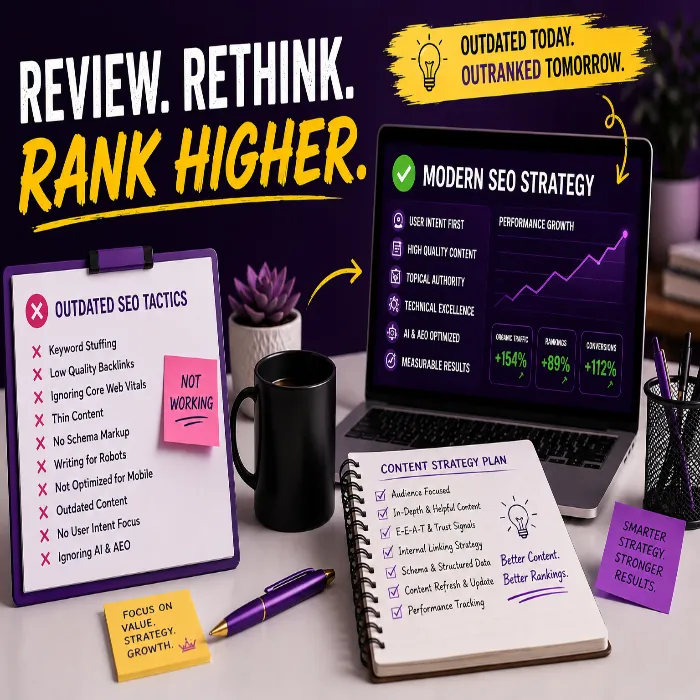
Old SEO vs Modern SEO (2026)
| Outdated SEO Tactics | Modern SEO Strategy (2026) |
|---|---|
| Keyword stuffing | Search intent + semantic SEO |
| Spammy backlinks | Authority links + digital PR |
| No schema markup | Structured data (FAQ, Article) |
| Thin content | Helpful, in-depth content |
| No internal linking | Topic clusters + link equity |
| Ignoring Core Web Vitals | Page experience optimization |
| Writing for bots | People-first + AI-readable content |
Here are 10 tell-tale signs your SEO playbook needs a serious upgrade, and exactly what to do about each one.
Sign #1
1. You Are Still Obsessing Over Keyword Density
Remember stuffing your focus keyword every 100 words because someone told you to hit a 1.5% density target? That era is gone. Google’s Natural Language Processing (NLP) models including BERT, MUM, and the latest Gemini-powered algorithms read content the way humans do. They understand context, synonyms, and semantic relationships.
If your content reads like it was written for a keyword counter rather than a real person, it will under-perform in both traditional search and AI Overviews.
Fix It
Write for people first. Naturally include your primary keyword, then build semantic depth with LSI terms, related questions, and entity-based language. Tools like Surfer SEO, Clearscope, or even Google’s own “People Also Ask” boxes are your best guides here.
Sign #2
2. Your Content Has No E-E-A-T Signals
Google’s Quality Rater Guidelines now place enormous weight on Experience, Expertise, Authority, and Trustworthiness, especially for YMYL (Your Money, Your Life) content covering health, finance, legal, and business topics.
If your blog posts have no author bio, no credentials, no original insights, and no references to real-world experience, Google’s quality raters and its algorithms, will treat your content as low-authority filler.
Fix It
Add detailed author bios with professional credentials. Reference first-hand experience and real-world data. Cite authoritative external sources. Get your brand mentioned or linked from trusted industry publications. E-E-A-T is not optional in 2026 it is a ranking requirement.
Sign #3
3. You Are Not Optimizing for AI Overviews or AEO
AI Overviews now appear at the top of search results for millions of queries. ChatGPT, Perplexity, Gemini, and Claude are directly answering user questions often without a single click going to any website.
If your content is not structured to be extracted and cited by AI engines, you are invisible in this new layer of search.
Fix It
Use Answer Engine Optimisation (AEO) principles. Write direct, concise answers in the first 2-3 sentences of each section. Use structured headers (H2, H3), bullet lists, FAQ schema, and definition-style formatting. Make your content scannable, quotable, and unambiguous.
Sign #4
4. You Have Ignored Core Web Vitals
Page experience has been a confirmed ranking factor since 2021. Core Web Vitals Largest Contentful Paint (LCP), Interaction to Next Paint (INP), and Cumulative Layout Shift (CLS) are Google’s way of measuring whether your site actually feels good to use.
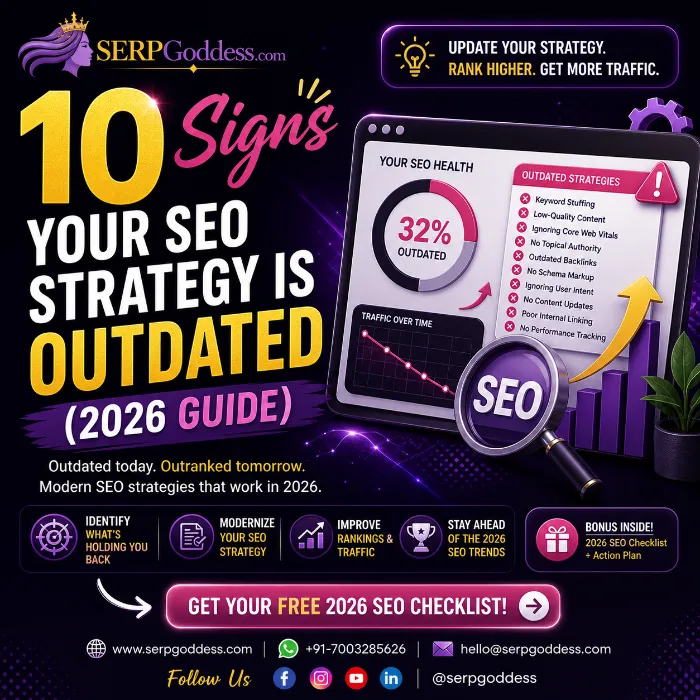
If your LCP is above 2.5 seconds, your INP is sluggish, or your page shifts around as it loads, you are losing rankings to faster, more stable competitors regardless of how good your content is.
Fix It
Run a Core Web Vitals audit via Google Search Console or PageSpeed Insights. Prioritise image compression (use WebP), eliminate render-blocking scripts, upgrade to faster hosting, and implement lazy loading. This is technical SEO that directly impacts user experience and rankings.
Sign #5
5. Your Link Building Relies on Purchased or Spammy Links
Buying links from link farms, PBNs, or low-quality directories was risky five years ago. Today, it is a fast track to a manual penalty or algorithmic demotion. Google’s spam algorithms have become remarkably good at identifying unnatural link patterns.
If your backlink profile is full of irrelevant, low-DR, or freshly-created sites, it is doing more harm than good.
Fix It
Pivot to Digital PR, thought leadership, HARO (Help a Reporter Out), genuine guest posting on reputable sites, and building shareable data-driven content that earns links naturally. Quality over quantity is the only link strategy that survives algorithm updates.
Sign #6
6. You Are Not Using Schema Markup
Structured data (schema markup) tells search engines and AI systems exactly what your content is about. It enables rich results like FAQ dropdowns, How-To steps, star ratings, product information, and event listings.
If you have no schema on your pages, you are leaving rich snippets on the table and making your content harder for AI systems to interpret accurately.
Fix It
Implement schema markup using JSON-LD (Google’s preferred format). At minimum, add FAQPage, Article, LocalBusiness (if applicable), and BreadcrumbList schema. Use Google’s Rich Results Test to validate your markup. Schema is one of the highest-ROI technical SEO tasks available to you right now.
Sign #7
7. You Are Targeting the Wrong Kind of Keywords
Chasing high-volume, ultra-competitive head terms like “SEO” or “digital marketing” made sense when the internet was smaller. Today, search intent and topical authority matter far more than raw volume.
If your keyword strategy is focused entirely on broad, high-competition terms without a strong mid-funnel and long-tail layer, you are probably ranking for nothing, converting nothing, and spending a fortune on content that goes nowhere.
Fix It
Build a keyword strategy around intent clusters. Map keywords to awareness, consideration, and decision stages. Prioritise long-tail, question-based, and comparison keywords where you can realistically compete. Use tools like Ahrefs, Semrush, or Google Search Console to identify low-hanging fruit in your existing content.
Sign #8
8. Your Content Targets Keywords, Not Topics
Google’s Helpful Content system and topical authority model reward sites that comprehensively cover a subject area, not sites that publish isolated blog posts targeting individual keywords.
If your content strategy is a random collection of keyword-targeted articles with no internal linking, no pillar pages, and no semantic cohesion, you are not building topical authority you are just creating noise.
When you build topic clusters, you’re not just organizing content you’re distributing internal link equity.
Each internal link passes authority between pages, helping Google understand which pages are most important and boosting rankings across your entire site.
Fix It
Build a topic cluster model. Create one comprehensive pillar page per core theme, then publish supporting cluster content around related subtopics. Link everything together intentionally. This tells Google (and AI systems) that your site is a genuine authority on the subject.
Sign #9
9. You Are Not Tracking the Right Metrics
If your monthly SEO report still leads with raw keyword rankings and total organic traffic, you are measuring the past. Rankings fluctuate daily. Traffic means nothing without context. What actually matters is whether SEO is driving qualified visits, leads, and revenue.
Vanity metrics give you a false sense of progress while the business stagnates.
Fix It
Shift your reporting to metrics that matter: organic traffic by intent category, conversion rate from organic, click-through rate (CTR) by page and keyword, Core Web Vitals scores, and share of voice in your target topic clusters. Connect Google Search Console to GA4 and build a dashboard that tells the full story.
Sign #10
10. You Have Not Thought About GEO (Generative Engine Optimization)
GEO is the newest frontier of search. As AI tools like ChatGPT, Perplexity, Google Gemini, Claude, and Microsoft Copilot become primary research tools for millions of users, the question is no longer just “will Google show my page?” it is “will AI cite my brand?”
If you have not considered how your content appears in AI-generated responses, you are missing an entirely new and rapidly growing discovery channel.
Fix It
Optimise for GEO by writing clear, factual, well-structured content that AI can easily extract and quote. Use statistics, define terms, answer questions directly, and structure your pages with logical H-tag hierarchies. Build brand mentions and citations across authoritative external sites. The more AI systems see your brand in trusted contexts, the more likely they are to surface it in generated answers.
How Topic Clusters Build SEO Authority
Think of your SEO strategy like this:
- Pillar Page: Main topic (e.g., SEO Strategy)
- Cluster Content: Supporting posts (technical SEO, link building, etc.)
- Internal Links: Connect everything
Frequently Asked Questions
1. What is an outdated SEO strategy?
An outdated SEO strategy relies on old tactics like keyword stuffing, spammy backlinks, and ignoring user intent, which no longer work in modern search algorithms.
2. Does keyword density still matter in SEO?
No, keyword density is no longer a ranking factor. Google now focuses on context, relevance, and semantic understanding instead.
3. What is E-E-A-T in SEO?
E-E-A-T stands for Experience, Expertise, Authority, and Trustworthiness, which Google uses to evaluate content quality, especially for important topics.
4. Why is AI optimization important in SEO?
AI optimization ensures your content can be understood and cited by AI tools like ChatGPT, Google Gemini, and Perplexity, increasing visibility beyond traditional search.
5.What is AEO in SEO?
“Answer Engine Optimization (AEO) focuses on structuring content so it can be directly used by AI systems and featured snippets.
⚠️ Disclaimer
I’m Dailyn Ociel, an SEO strategist based in the Philippines, and the insights shared in this article come from real-world experience working with both local and international clients.
This content is provided for educational and informational purposes only. While I aim to share accurate and up-to-date SEO strategies, search engine algorithms and AI-driven systems are constantly evolving, and results may vary depending on your industry, competition, and implementation.
I do not guarantee specific rankings, traffic growth, or business outcomes. You should use this information as a guide and adapt it based on your own data, or consult a qualified SEO professional before making major changes to your website or digital strategy.